The Evolution of LFP Powder Compact Density: A Decade from 2.2 to 2.7
1. The Bottom Line First
Over the past decade, the powder compaction density of lithium iron phosphate (LFP) has risen from about 2.2 g/cm³ to 2.65 g/cm³ in large-scale mass production, while fifth-generation products are now pushing beyond 2.7—an increase of about 20%, even though not a single atom in the crystal structure of LiFePO₄ has changed.

The battle over the past decade has not been a "chemistry battle," but a "materials-processing battle": how to pack the same material more tightly. Compaction density is a major engineering challenge left by LFP—it directly determines how many grams of active material can be packed into a unit volume, and therefore determines the volumetric energy density of the cell.
2. Why Was the Starting Point So Low? — Three "Locks"
The starting point of 2.2–2.3 g/cm³ was no accident; it was the inevitable result of three constraints acting at the same time.
Lock 1: The Physical Lock — LFP Starts at a Disadvantage
· Its theoretical density is only 3.60 g/cm³, one level lower than ternary cathode materials.
· "For high-rate performance, particles need to be fine; for high compaction, they need to be coarse." This is an inherent structural contradiction in LFP.
· The packing ceiling: even if all particles were ideal spheres, random packing of monodisperse spheres reaches only about 64% volumetric efficiency. Without particle-size grading or morphology engineering, LFP compaction naturally stalls around 2.3.
Lock 2: The Process Lock — Ferrous Oxalate "Won't Sinter Dense"
Around 2015, the mainstream process was the ferrous-oxalate solid-state route. It had two major drawbacks:
· Gas generation: ferrous oxalate releases large amounts of CO/CO₂ during sintering. The gas pushes particles apart, preventing small particles from bonding and growing together (forming "sintering necks"). As a result, the powder remains composed of fine particles and compaction stays low.
· Inaccurate stoichiometry: the raw material FeC₂O₄·xH₂O contains a variable amount of water, making the iron addition difficult to control precisely. Stoichiometry drifts, and yield suffers as well.
Lock 3: The Industry Lock — Industry Marginalization
Industry marginalization: from 2010 to 2019, subsidies favored ternary batteries. In 2019, LFP accounted for only 14.29% of power-battery installations (versus 82.59% for ternary materials). Being pushed to the market's margins meant little serious investment in studying "how to stack the bricks."
With all three locks acting together, 2.2–2.3 was not a sign of inadequate technical capability, but the combined result of "physical limits + rough processing + market-use orientation."

3. How Did It Rise Step by Step? — Four Steps Up the Ladder
Step 1 (2016–2019): Correct the Misconception, Then Improve Conductivity — 2.2 → 2.4
The key at this stage was not a "process revolution," but two things:
1. 1. Break the misconception that "the finer the particles, the better." A systematic 2018 study provided clear data: commercial LFP (D50≈1.46 μm) achieved compaction densities of 2.38–2.52 g/cm³, while a finer sample (D50≈0.74 μm) reached only 1.8–2.0 g/cm³. Fine particles have higher specific surface area, absorb more binder, and are more prone to "arching" between particles. Finer is not always better; compaction and rate capability must be balanced.
2. Maturation of nanosizing + carbon coating. Nanosizing addressed conductivity and rate performance (earlier research showed that ~140 nm carbon-free LFP could still deliver 147 mAh/g at 5C without carbon coating), while carbon coating increased electronic conductivity by several orders of magnitude. But this also brought the "nanosizing vs. compaction" conflict to the forefront: nanoscale particles preserve rate capability, while high compaction favors coarser particles. A compromise is unavoidable.
Result: the industry moved from 2.2–2.3 to 2.3–2.4, with commercial samples reaching 2.38–2.52.
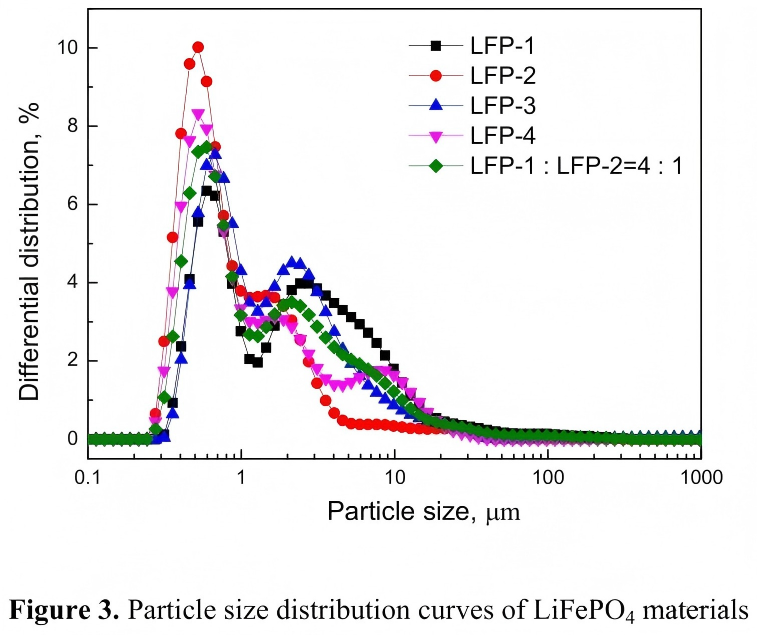
Figure 4. Particle-size distribution comparison between commercial LFP (D50≈1.46 μm, compaction density 2.38–2.52 g/cm³) and a finer sample (D50≈0.74 μm, compaction density only 1.8–2.0 g/cm³). Finer particles are not necessarily better; compaction and rate capability must be balanced. Original figure from Chen et al. (2018).
Step 2 (2020–2022): Change the "Flour" and Make the Particles Round — 2.4 → 2.5
2020 was a watershed year. In March, BYD launched the Blade Battery (CTP, module-free; battery-pack space utilization increased from 40% to 60%+), reigniting demand for LFP through system-level innovation. In July 2021, LFP's share of power-battery installations stably exceeded 50% for the first time, overtaking ternary batteries. Once demand recovered, material upgrades gained momentum. On the technical side, two major advances were completed in parallel:
1. 1. Change the precursor: the iron phosphate (FePO₄) route completed its industrial-scale replacement of the older route—gas generation dropped sharply, the Fe/P ratio became controllable, stoichiometry became reliable, and particles could finally grow normally. The "standard flour" was finally in place.
2. Make the particles round: spray-drying granulation became standard practice—nanoscale primary particles preserve rate capability, while spherical secondary particles improve packing, delivering the best of both worlds.
At the same time, coarse/fine particle-size grading began moving from academic papers to production lines. The grading experiment by Chen et al. in Step 1 showed that mixing coarse and fine particles at a 4:1 ratio could increase compaction by 18%; at this stage, manufacturers began turning it into a mass-production process.
Result: the industry reached roughly 2.4–2.5.

Figure 12. Formation mechanism of LFP microspheres: solution → nucleation (LiFePO₄ nanoparticles) → self-assembly → growth → micro/nano spherical secondary particles—the process essence of "making the particles round." Original figure from Yuqing Qiao et al., Materials (2022).
Step 3 (2023–2025): Process Refinement and Multi-Technology Integration — 2.5 → 2.65
In August 2023, CATL launched the Shenxing Battery—the world's first LFP 4C superfast-charging battery—combining "high compaction + fast charging" for the first time. In 2024, the industry formally defined ≥2.6 g/cm³ as "high-compaction-density LFP," making compaction density a hard benchmark for product grading. The upgrades at this stage came as a coordinated package:
· • Two-stage sintering: moving from "one-pot firing" to a staged approach—first a lower-temperature stage (about 600–650°C) to control crystallization and particle size, followed by a higher-temperature stage (about 750–800°C) for densification. A single-step process can cause uncontrolled particle coarsening; staged control is needed to balance "particle growth" and "compaction density" (industry process description). Another route uses precisely controlled single-stage sintering (Lopal S526, powder compaction density 2.62).
· • Mass production of particle-size grading: three engineering approaches—batch blending, post-spray blending, and slurry blending—matured, turning grading from an "experimental trick" into a "standard process."
• Doping + multilayer carbon coating: Mg/Ti and other dopants improve conductivity, allowing particles to be coarser and denser. Carbon coating has moved toward "thinner and more uniform" layers (the density of the carbon layer is only about half that of LFP; every additional 1% of carbon dilutes compaction—samples with 1.64% carbon content can fall to 1.90 g/cm³).
Result: Yunnan Energy New Material reached mass-production levels as high as 2.65 (third-party measured YN-13 at 2.63), while Easpring advanced from Gen 3.5 at 2.58 to Gen 4.5 at 2.68. High-compaction products began commanding a premium of about RMB 1,000–3,000 per tonne.

Figure 13. Comparison of two LFP packing models: left—large particles form the skeleton while small particles fill the gaps, creating dense packing; right—single-size particles pack loosely. This is the physical basis for improving compaction through particle-size grading. Original figure from Zhong & Zhou, Mater. Chem. Phys. (2010).
Step 4 (2025–2026): Push Toward 2.7 and Start Challenging the "Physical Limit" — ≥2.70
Fifth-generation products with LFP powder compact density ≥2.70 are approaching mass production: Easpring's fifth-generation 2.75+ product has completed process finalization and mass-production validation and secured hundred-tonne-scale orders from leading customers; Defang's fifth-generation 2.70–2.75 products are progressing smoothly through downstream validation. But note one number: the upper limit for hexagonal close packing (HCP) of monodisperse spheres is 0.74×3.6 ≈ 2.66 g/cm³—meaning 2.65 is already right at that limit. From 2.65 upward, every additional 0.05 requires real engineering work in particle-size grading, sphericity, and process dispersion to break through the physical limit of monodisperse packing.

Figure 14. Microstructure of LFP/C samples produced by controlled crystallization with high tap density (literature reports tap density on the order of 2.0 g/cm³). Reaching 2.7 g/cm³ powder compaction density depends on optimizing every link—"spherization + grading + sintering necks"—to the limit. Original figure from Yu et al., RSC Adv. (2014).
4. Summary: Six Methods at a Glance of LFP Powder Compact Density (Each to Be Explained Later)
A decade of experience can be condensed into one checklist—this is also the roadmap for the articles that will follow:
# | Method | One-Sentence Principle |
1 | Precursor route (iron phosphate vs. ferrous oxalate) | Less gas generation and accurate stoichiometry allow particles to grow |
2 | Sintering protocol (temperature / two-stage sintering) | Control particle growth and densification while suppressing Fe₂P magnetic impurities |
3 | Particle-size grading (coarse + fine) | Fine particles fill gaps between coarse particles, delivering the largest gain (measured +18%) |
4 | Morphology control (spherization / nano-secondary composite) | Good morphology naturally produces better packing |
5 | Doping modification | Better conductivity allows particles to be denser |
6 | Carbon-coating optimization | Balancing conductivity and compaction |
None of these six methods looks remarkable on its own, but together they pushed compact density from 2.2 to around 2.7.

